
Puyallup, WA · Garage Door Service
What a Service Call Actually Covers in Puyallup
A service call on a Puyallup house built between 1938 and 2003 covers more than a quick fix - here's what's actually on the checklist, and why it matters.
- Repairs & new doors
- Springs & openers
- Serving 6 nearby communities
Where People Go Wrong
Puyallup's housing stock runs from 1938 to 2003, with a median build year of 1988, and most of the 43 named areas we work in fall squarely into that 1980s-90s wave. That matters because people assume a door looks fine, so it is fine. A door installed when a 1988-built house went up is now pushing 35 years old, and torsion springs are rated in cycles, not calendar years - a spring on a house from that era has usually seen its full rated life and then some.
The other mistake is treating every door the same. Houses built in the late 80s and early 90s often used different winding cones, lower-gauge track, and lighter-duty rollers than anything installed after 2000. A tech who doesn't check the install era before quoting a repair is guessing. We look at the door's apparent age against the house's likely build window before we touch anything, because a fix that's right for a 2001 door can strip hardware on an 88.
What the Weather Here Does to It
Puyallup sits in a cold-moderate climate band - not the kind of cold that cracks steel in one event, but the kind that works on a door slowly through repeated freeze-thaw swings across the wet months. Moisture gets into wood jambs and steel bottom panels on the older end of that 1938-2003 stock, rust starts at the hinge pins and track brackets, and lubricant that was fine in September turns gummy on a cold morning in January, making the opener strain against resistance it shouldn't have to fight.
We don't see doors here get destroyed by a single storm. We see them fail from years of that damp-cold cycle doing quiet damage to fasteners and springs that nobody was watching. That's the honest difference between service calls in a hard-freeze climate and service calls here: the failure mode is corrosion and fatigue, not sudden breakage from extreme cold.
What Changes With the Season
The fall-to-winter stretch is when condensation shows up inside insulated panels on houses from that 1980s-90s build wave - warm garage air meeting a cold steel skin, same as it would on a window. Owners call about drips they think are a leak in the door itself, when it's really moisture forming on the inside face.
Spring is when seized hardware finally gets found. Rollers and spring coils that sat through a few months of damp cold suddenly get asked to move fast as the weather warms, and that's when a stiff spring snaps rather than just creaking.
Summer calls read differently. Heat and UV on older weatherstripping and wood trim - more common on the earlier end of the 1938-2003 range - cause the rubber seal to shrink and the jamb to dry out and crack, which shows up as daylight gaps and drafts once the weather turns again. None of this is dramatic. It's steady wear tracking the season, which is why the right fix depends on when you call, not just what you hear.
What Is Going On
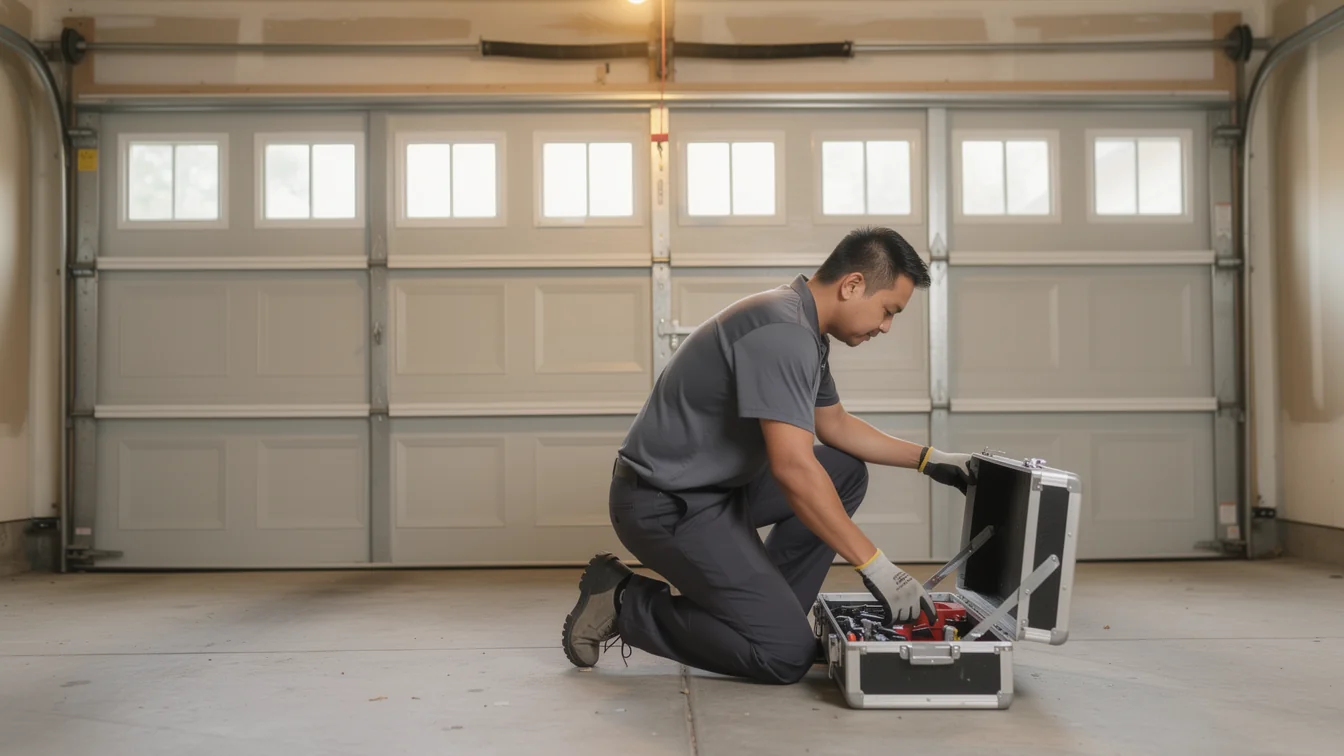
A real service call starts with the spring - type, wind, and wear relative to the door's likely install era, since a late-80s torsion setup and a 2000s one don't share hardware. Next is track alignment, checking for the shims and bracket adjustments common on older framing where the opening has settled a little over three or four decades. Then the opener: force and limit settings, because a motor straining against stiff cold-weather resistance will burn itself out trying to compensate for a spring problem it can't fix.
We check panels for rust at the bottom section and hinge points, and we check the weatherstripping and bottom seal for shrinkage or cracking. What we don't do is structural carpentry - if the wood jamb around the door has gone soft from years of moisture, that's a repair for someone who frames for a living, not a garage door ticket. We'll tell you when that's the case instead of patching around it.
The goal of the call is to tell you which of those things is actually the problem, because on a house from this area's build era, it's rarely just one.
Frequently asked questions
Why does my garage door spring keep breaking even though it's not that old?
Springs are rated by cycle count, not years. If your house was built in Puyallup's common 1980s-90s window, the original spring has likely logged tens of thousands of open-close cycles already. Cold, damp weather accelerates fatigue on top of that. A spring that's near the end of its rated life can snap on a normal morning, with no warning.
Is it normal to see moisture inside my garage door panels in winter?
Yes, especially on insulated steel doors common in houses built through the 1980s and 90s. Warm garage air meets the cold outer skin and condenses on the inside, same as a window. It's usually not a leak. If it's pooling and causing rust at the bottom panel, that's worth a look.
Do you work on doors in Sumner, Edgewood, or Fife, not just Puyallup?
Yes, we cover Puyallup and the surrounding area including Summit, Edgewood, Sumner, Fife, and Milton, generally within a few miles of town. Housing stock and climate are similar across that area, so the same checks apply.
Will you just replace my door instead of fixing it?
Only if the repair doesn't make sense. If the spring, track, and opener are all original from a house built decades ago and multiple parts are failing at once, patching one piece at a time can cost more than a replacement. We'll say so if that's what we find, rather than stacking repairs.
Related garage door services in Puyallup
More garage door guides
Book garage door service in Puyallup
Call now or request a quote - tell us what the door is doing and where you are.