
Puyallup, WA · Garage Door Service
Garage Door Opener Installation for Puyallup Homes
Opener installs built around Puyallup's 1980s-90s housing stock and cold winters. What fails, what a proper install takes, and when replacing beats repairing.
- Repairs & new doors
- Springs & openers
- Serving 6 nearby communities
Why This Fails Locally
Most houses in this service area went up between 1938 and 2003, with the bulk of that stock dating to the 1980s and 90s. That matters for openers because a chain-drive unit installed when the house was built is now 25 to 40 years old - well past the design life of its gears, capacitor, and logic board, even if the motor still runs on a good day.
The cold moderate climate here adds a second problem on top of age. Grease in an old gear housing thickens in winter, the drive chain tightens as metal contracts, and a motor already working at the edge of its life draws more current than it should just to get a cold door moving in January. That combination - an aging opener plus a cold start - is why January and February bring more opener calls than any other stretch of the year, and why a unit that's merely slow in July can stop working entirely once temperatures drop.
This isn't a problem specific to one house. Across the roughly 112,589 owner-occupied houses in this area, a large share were fitted with openers in that same build-out window, which means a large share are hitting end-of-life on roughly the same clock.
What the Repair Takes
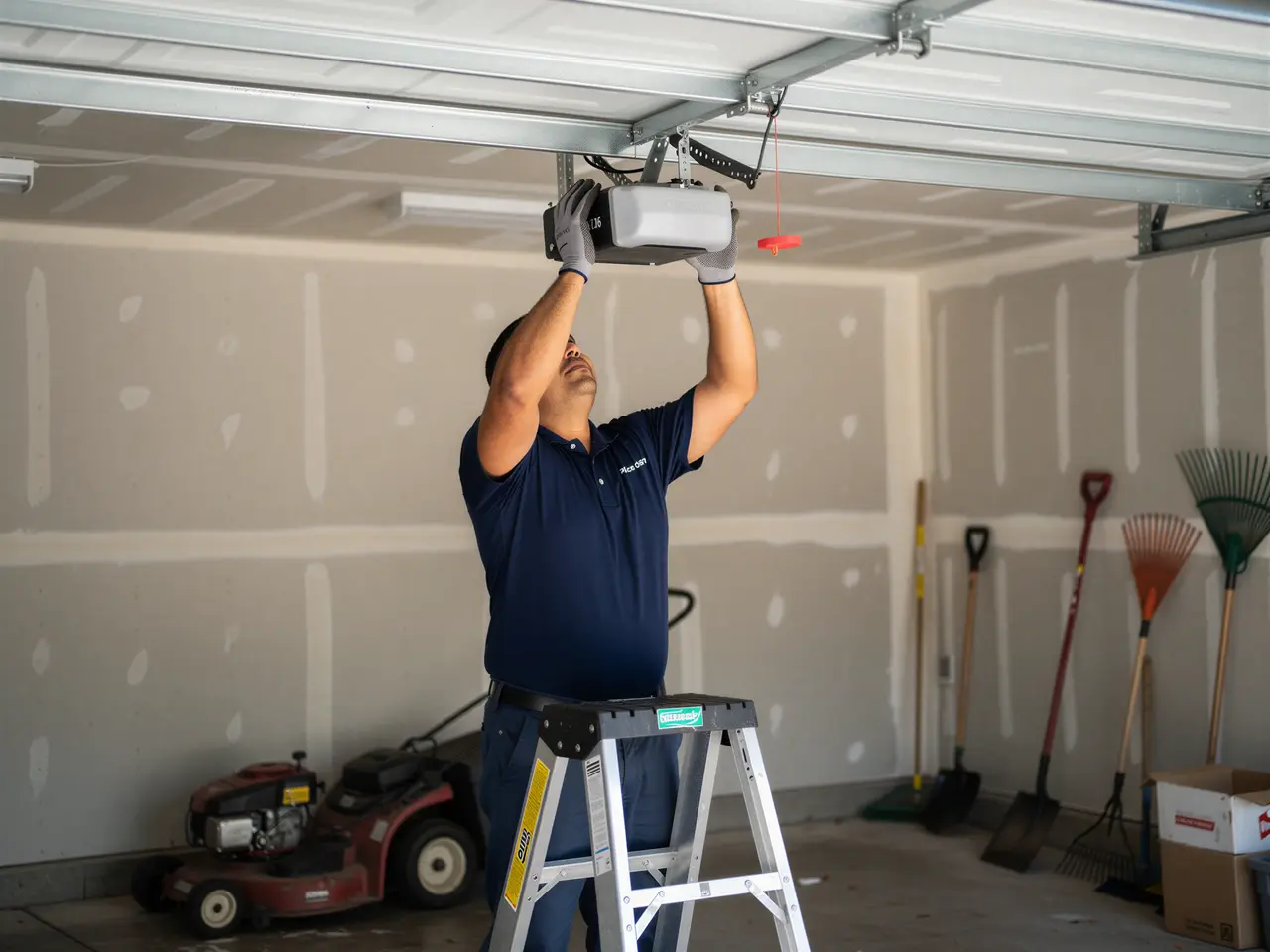
A straight opener swap on a standard door - pull the old unit, hang a new rail and motor, wire the wall control and safety sensors, set the travel limits and force settings - is most of the job on a typical install. Where it gets longer is the stuff tied to the house's age: brackets rusted onto a 1980s header, a safety sensor wiring run that was never up to current code, or a door spring that's clearly next to failure and shouldn't be loaded onto a new opener without being addressed first.
We test the balance of the door before we mount anything. An opener fighting an unbalanced door burns itself out early no matter how new it is, and that's a common finding on doors this age that have never had the springs checked.
One limitation worth saying plainly: if the existing rail, header bracket, or wiring is seized or out of code, that adds time and parts cost beyond a bare motor swap, and we won't know the exact scope until we're looking at the installation in person.
How It Shows Up
The early signs are usually small. The door starts hesitating partway up, especially on a cold morning, then reverses a few inches before trying again. The wall button works but the remote lags by a second or two. You hear a grinding note from the motor housing that wasn't there a year ago.
Later it's binary - the door won't move at all, or it moves a few inches and stops, tripping the breaker or the motor's internal thermal cutoff. On older units without rolling-code security or modern safety reversal, there's also a real safety gap: some of the chain-drive openers common in 1980s and 90s construction here predate the force-sensing standards openers are built to now, which is a separate reason to replace rather than keep nursing one along.
If your opener is original to a house built in that era, age alone is doing most of the damage, cold weather is just what exposes it.
The DIY Question
A homeowner comfortable with a ladder and a drill can hang a new opener. The parts that trip people up are the safety sensor alignment, setting the down-force limit so the door doesn't crush something, and reading a door that's actually out of balance versus one that just needs a new motor.
Given the median household income in this area is $107,781, a lot of homeowners here could buy the opener kit outright - but the kit isn't the hard part. Getting the force setting wrong on a door with a weak spring is how people end up with a door that reverses on a car bumper or a door that comes down hard enough to matter. If your springs are original to the house and you're not sure of their condition, that's worth having looked at before any new opener goes on top of them, DIY or not.
Frequently asked questions
How old does an opener have to be before replacing beats repairing it?
If the motor, logic board, and drive system are all original to a house built in the 1980s or 90s, you're usually past the point where a single part fix makes sense - the rest of the unit is on the same clock. A new installation with a modern safety-reversal system is the more defensible call at that age.
Does cold weather actually cause openers to fail here?
Cold doesn't create the failure, it exposes one that's already there. Thickened grease and a tightened chain make an aging motor draw more current to start a cold door, which is why opener calls climb in the coldest stretch of winter even though the unit ran fine all summer.
Can I put a new opener on a door with old springs?
Not without checking the springs first. An opener works against spring tension, not instead of it, and loading a new motor onto a worn or unbalanced spring system shortens the new opener's life and can make the force settings unsafe. We check balance before any install.
Related services
By Neighborhood
Opener Installation across the Puyallup area
We also handle opener installation in these Puyallup-area suburbs.
Book garage door service in Puyallup
Call now or request a quote - tell us what the door is doing and where you are.